Multidimensional energy poverty and childhood respiratory health across 26 low and lower middle income countries
All methods were executed in accordance with the relevant guidelines and regulations.
Study framework
The most recent Multiple Indicator Cluster Surveys (MICS) from 2017 to 2023 were employed to conducted this analysis consisting of sample collected from 26 LLMICs. These surveys are population-based, nationally representative surveys that employ a standardized methodology and are supported by the United Nations Children’s Fund (UNICEF). The MICS are approved by the national ethical committees from each country. A two-stage sampling approach is followed by each country, defining clusters in the first stage followed by large-sized random samples of households in the second stage. The questionnaire method is used to collect primary data from households and women after informed consent. No additional human consent or ethical approval is required as this study used secondary data. The MICS typically achieved large sample sizes in each country with detailed information using household and women’s questionnaires. The women’s questionnaire records information from females within reproductive years (15–49) and their children aged under five. The UNICEF’s Multiple Indicator Cluster Surveys (MICS) employs standardized uniform questionnaires, sampling techniques, and interviewer training to secure consistency across countries. Although minor regional differences in field implementation may occur, these are limited by the harmonized survey design and quality assurance mechanisms applied by UNICEF.
Target population
The selection of MICS surveys for this study was guided by five criteria: (1) availability of MICS data collected between 2017 and 2023, (2) inclusion of children residing in LLMICs as classified by the World Bank,22 (3) availability of indicators used to measure MEPI6, (4) presence of cough and shortness of breath measures, which together define ARI following UNICEF-MICS guidelines,23 and (5) availability of covariates. The initial selection comprised 393,501 children across 29 LLMICs. For the final analytic sample, five countries with missing essential variables and children with incomplete data on dependent or independent variables (n = 49,341). After exclusions, the final dataset consisted of 344,160 children aged under five across 26 countries including 11 low and 15 lower middle income countries.
Acute respiratory infection
The dependent variable was the occurrence of ARI among children below the age of five. Following UNICEF definitions23, ARI (yes/no) was classified as the occurrence of cough together with short, rapid, or labored breathing within the two weeks prior to the survey. Information on cough and shortness of breath was integrated and coded as a dichotomous outcome (presence/absence). Mothers were first asked: “Has (name) had an illness with a cough at any time in the last two weeks?” with answer choices of yes, no, or don’t know. Children with responses of don’t know were excluded. For children who reported a cough, the follow-up question varied across survey years. Between 2012 and 2014, mothers were asked: “When (name) had an illness with a cough, did he/she breathe faster than usual with short, rapid breaths or have difficulty breathing?” Since 2015, this question was uniformly applied to all children, irrespective of cough status: “Has (name) had fast, short, rapid breaths or difficulty breathing at any time in the last two weeks?” In either case, mothers selected from yes, no, or don’t know. Cases of ARI were defined as children presenting with both cough and shortness of breath. Cases reporting cough but with uncertain responses for shortness of breath were excluded; children without cough were categorized as non-ARI.
Energy poverty
Multidimensional energy poverty was assessed using the MEPI, which captures household deprivation in five essential energy service dimensions through seven indicators Table 1: (1) use of biomass fuels for cooking, (2) indoor air pollution from cooking, (3) household electrification (4) household appliance availability, (5) ownership of entertainment/education appliances, and (6) ownership of telecommunication devices. The use of biomass fuels for cooking reflects reliance on polluting energy sources, while indoor air pollution from cooking and lighting specifies the degree of exposure to harmful pollutants within the dwelling. Exposure is especially elevated when cooking or heating takes place indoors without a separate kitchen. To better capture this household exposure, we used a modified version of the MEPI that incorporated indoor air pollution from lighting in addition to cooking. Financial accessibility of energy is further measured through educational and communication services and home appliance ownership. The modified MEPI is employed by including indoor pollution from lighting sources and additional appliances to better capture recent deprivations. Indoor pollution caused by lighting measures inefficiencies in modern energy sources, reflecting environmental effects and energy deprivation. A broader domain of energy facilitation for education and health can be captured by considering additional household appliances. These indicators were selected carefully in accordance with the theoretical framework of MEPI to maintain validity and present a more comprehensive analysis of energy. The extended index was adopted to test the hypothesis that MEPI, including new variables, is associated with ARI among children. To broadly capture energy-driven pathways that may independently impact ARI likelihood, additional indicators related to lighting, appliances, and telecommunication are incorporated in the modified MEPI. The weight before and after adding an indicator within a dimension is calculated as follows: the basic framework of MEPI computes the weight of lightning (0.2), considering only one indicator of electricity access (0.2), but the current index calculated this weight by considering two indicators: electricity access (0.1) and indoor air pollution (0.1). The earlier version of MEPI only considered ownership of a fridge (0.13) as a household appliance, while the present index splits the weight of this dimension into ownership of a refrigerator(0.43), washing machine/dryer (0.43), and air cooler/fan (0.43), and so on.
A modified version of the MEPI presented in Table 1 was constructed by incorporating additional relevant indicators of household energy deprivation: indoor pollution from lighting (77.4%), absence of a washing machine (77.7%), absence of an air cooler/fan (67.3%), absence of a computer (92.1%), and absence of internet access at home (77.4%). Indoor pollution was assessed using two variables: (1) availability of a dedicated cooking room and (2) type of household lighting. Household appliances were measured through three variables: absence of a refrigerator, washing machine, and air cooler/fan. The entertainment/education dimension was assessed through three indicators: absence of a radio, absence of a television, and absence of internet access at home. Consistent with Nussbaumer et al. (2012)6, if the weighted sum of deprivations across dimensions exceeded a cut-off value of 0.30, the households were considered as energy poor. The MEPI score was normalized to range between 0 (no energy deprivation) and 1 (maximum energy deprivation) for analytical consistency before regression modeling and the estimated values should be considered under this scaling. Accordingly, the adjusted odds ratio measures the effects associated with a complete-scale increment in the index. According to available indicators of the relevant dataset, an extended MEPI was constructed, adapting the primary multidimensional framework suggested by Nussbaumer et al. (2012), after minor adjustments. Finally, after adjusting the indicator and weights, the index consisted of five central dimensions, including cooking, lighting, household appliances, entertainment/education, and communication (Table 1). These modifications increase empirical application without altering the basic conceptual structure of the genuine MEPI. The weighting scheme for the MEPI followed Nussbaumer et al. (2012), assigning equal importance to each of the five dimensions. Although additional indicators such as internet access and type of lighting were incorporated to capture emerging aspects of energy deprivation and ensure alignment with available MICS variables, these were nested within existing dimensions without altering their relative weights. Consequently, the proportional contribution of each dimension remained consistent with the original MEPI formulation, thereby preserving conceptual comparability while enhancing construct validity.
Covariates
Theoretical relevance and availability of consistent variables in the MICS datasets across the 26 countries were the main concerns in selecting the covariates. To ensure comparability across nations, incomplete or inconsistently reported variables, such as parental occupation and household members, were excluded from regression analysis. Further, these variables showed high multicollinearity with socioeconomic variables such as household wealth and urban–rural residence. This approach is adopted to obtain stable estimates with minimum multicollinearity. For covariate selection, child-related variables included age (in years) and gender (male/female), economic characteristics were represented by the household wealth index (poor/middle/rich), and place of residence (urban/rural) was considered as an environmental factor. Age was included in the models as discrete variable consistent with theoretical definitions applied in child health related assessments to improve interpretability since risk descriptions vary across various developmental phases (infant, toodler, early childhood). All available polluting lightning sources with different emission combustion were grouped into a single category according to the literature, and hence, logically differentiate between nonpolluting and polluting lightning means.
Statistical methods
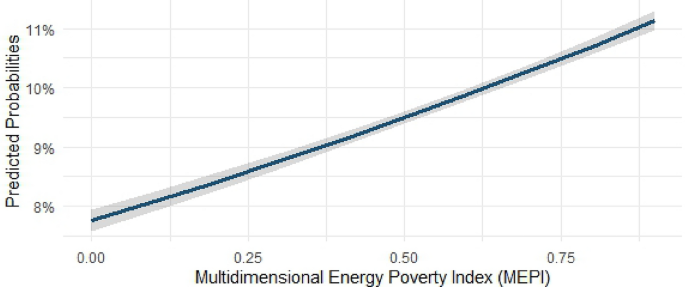
Initially, descriptive analysis presented frequencies and percentages for qualitative variables and means with standard deviations (mean ± SD) for quantitative factors. The listwise deletion method is adopted to exclude missing observations. A binary logistic regression model is applied to assess the association between ARI and energy poverty. Additionally, analyses were extended to examine the relationship between ARI and MEPI indicators independently. Logistic regression models were adjusted for the child’s age, gender, place of residence (urban/rural), wealth index, and country of residence. To avoid multicollinearity and maintain parsimony, maternal education and regional effects were excluded from the pooled adjusted models, as these variables were highly correlated with the household wealth index and urban–rural residence. Instead, regional variation was regressed separately to examine region-wise associations between ARI and MEPI, ensuring sufficient exploration of contextual heterogeneity. The statistic Nagelkerke’s \(R^{2}\) was computed to evaluate model performance, and the variance inflation factor (VIF) was measured to assess multicollinearity. Further, stratified analyses were performed to examine whether the association between ARI and MEPI varied by child’s age group and geographical region. The level of significance was set at \(p< 0.05\). The R version 4.5.1 is used for analysis. All significance levels were reported as \(p < 0.001\) rather than displaying extended decimal values, to maintain consistency and readability. This approach ensures a uniform three-decimal reporting format across all tables and aligns with standard practices for large-sample analyses where very small p-values provide similar inferential interpretation. The MEPI was analyzed primarily as a continuous, normalized index (range 0–1) to capture the full gradient of multidimensional energy deprivation. In addition, for comparative purposes, we estimated a binary indicator of energy poverty (yes/no) using a predefined threshold. The dichotomous specification is presented as a secondary analysis; results from both specifications are reported to facilitate interpretation and policy relevance.
Binary logistic regression model
A binary logistic regression model was employed to examine the association between multidimensional energy poverty (MEPI) and acute respiratory infection (ARI) among children under five years of age. The model was specified as:
$$\begin{aligned} \text {logit}(P_i) = \beta _0 + \beta _1 \text {Z}_i + \beta _2 X_i + \varepsilon _i \end{aligned}$$
(1)
where \(P_i\) denotes the probability of ARI occurrence for child \(i\), \(\text {Z}_i\) represents the explanatory variable (energy poverty, MEPI, Use of biomass fuels for cooking etc.), and \(X_i\) is the vector of covariates (child’s age, child’s gender, urban–rural area, wealth status).
Analytical approach
All analyses were conducted using unweighted data to maintain region comparability. Although MICS datasets are based on complex survey designs, survey weights were not applied because the objective was to examine associations rather than generate nationally representative estimates. To account for heterogeneity across regions, region fixed effects were included in the regression model to assess variation in the MEPI–ARI association across major LLMIC regions. This specification controls for unobserved, time-invariant characteristics unique to each region while allowing for consistent estimation of within-region associations. Although a multilevel logistic regression framework could provide additional insights into hierarchical variation, the fixed-effects approach was selected for simplicity and comparability across regions with differing sample sizes. To assess the region-specific associations, logistic regression analyses were conducted, stratifying the 26 countries into five geographic regions based on UNICEF and World Bank regional classifications: Sub-Saharan Africa (Benin 2021, Central African Republic 2019, Comoros 2022, Democratic Republic of Congo 2018, Eswatini 2021–22, Gambia 2018, Ghana 2017, Guinea 2018, Madagascar 2018, Malawi 2020, Nigeria 2021–22, São Tomé and Príncipe 2019, Sierra Leone 2017, Togo 2017, Zimbabwe 2019), South Asia (Bangladesh 2019, Nepal 2019, Pakistan 2018–19), East Asia & Pacific (Kiribati 2018, Samoa 2019, Vietnam 2023), Middle East & North Africa (Algeria 2018–19, Tunisia 2021, Yemen 2022–23), and Latin America & the Caribbean (Honduras 2019). This stratified analysis examine the consistency of the MEPI–ARI associations across regions, thereby accounting for cross-regional heterogeneity in energy access, socioeconomic status, and environmental conditions. The intraclass correlation coefficient across regions is 0.03 showing 3% of the total variation was accountable to regional clusters justifying effective multilevel modeling.
link