Improved cookstoves enhance household air quality and respiratory health in rural Rwanda
Study sites
The study was conducted in the districts of Musanze and Gatsibo in Rwanda (Fig. S1). Musanze district (1.3°S, 29.3°E, average altitude of 1860 m a.s.l., 476.500 inhabitants) is located in northwest Rwanda in the country’s most mountainous region, spanning an area of 530 km242. The local climate is mainly humid, with an average temperature ranging between 13 and 18 °C, and maximum precipitation occurring in April and November (1300 to 1600 mm per year43,44). Gatsibo district (1.6°S, 30.4°E, 1465 m a.s.l., 551.100 inhabitants) is located in eastern Rwanda, covering an area of 1585 km2. The predominant geography consists of flat land and small elevations45. The climate is mainly hot and dry, with an average temperature of 25 to 27 °C and increased precipitation from March to May and October to December (700 to 1100 mm per year44. A significant fraction of the population in the study sites relied on agriculture as their primary income source: 57% and 72% of the employed adults in Musanze and Gatsibo worked as independent farmers, respectively46,47.
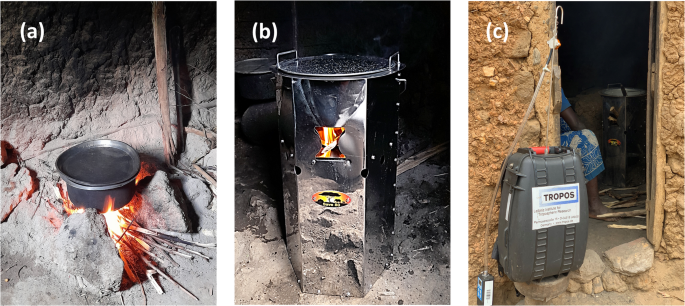
Firewood was the most common fuel used for cooking by Musanze (78%) and Gatsibo (92%) households48,49. Wood was collected from surrounding bushes, trees, and parcels, or bought from neighbors or nearby sellers. Traditional cooking primarily involved indoor open fires using a “three-stone” setup, where stones were arranged to support a cooking pot and confine the firewood (see Fig. 1a). Variations of the three-stone fire were also observed, such as the “u-shaped” setup, which constituted a fixed built-in structure used to contain firewood (see Fig. S2a).
Study design
We conducted a randomized controlled trial in adults from the two study regions over a three-year period (September 2019 to May 2022), in which blinding was not possible due to the nature of the intervention. Participants were recruited through local farming cooperatives with the support of the NGO Safer Rwanda, focusing on adults responsible for cooking in their homes. Details about the study were provided to the communities in spoken and written form in French and Kinyarwanda. Following an initial expression of interest, participants were screened based on predefined inclusion and exclusion criteria (being at least 18 years old, not having chronic respiratory diseases, and not having an improved cookstove at home). Participation was entirely voluntary, without any financial or material compensation. Both oral and written consent were obtained from each participant. The ethics committee from the University of Lübeck, in Germany, assessed and approved the study protocol (protocol reference number 19–309), which follows the ethical principles of the World Medical Association Declaration of Helsinki from 2013, the most recent version of the Declaration by the time of the design and execution of the study.
The assignment of Save80 cookstoves to households was done through a simple random allocation process with a numbering generator. Participants were grouped into an intervention group and a control group. The intervention group received the stove at the beginning of the study, while the control group received it at the end. After receiving the stoves, participants were trained to use the devices. Safer Rwanda and local community leaders performed regular meetings, phone calls, and visits to households to verify the continuity and correct use of the stoves over the study period.
The first and second health assessments were conducted in 2019 and 2022, respectively (further details are provided in Sect. Health assessment).
Household air pollution measurements were performed only in 2022 during the second health assessment. The HAP measurements were performed on a subsample of households that did not receive the ICS during the first round, i.e., the control group, to build a baseline on air pollution before and after the intervention. The households monitored during the HAP assessment were selected considering their accessibility from the community halls serving as operational centers for the health assessments, since the batteries of mobile instruments need to be charged to operate prior to each measurement round (many houses lacked an electricity supply by the time of the study). HAP was measured over two rounds in 2022: in the first, households cooked using traditional methods, while in the second, households cooked using an ICS type Save80 after receiving training on correct stove usage. Further details on the HAP assessment are given in Sect. Exposure assessment.
The Save80 cookstove
The Save80® is a natural draft stove built on stainless steel and fueled using firewood. It consists of a pot and a quadratic combustion chamber underneath, and small wood sticks are inserted into the combustion chamber through a frontal opening (see Fig. 1b). The cookstove was characterized under laboratory-controlled conditions at the Institute of Combustion Technology, RWTH, in Aachen, Germany, and showed an improvement factor of 4.7 in thermal efficiency analysis compared to the traditional three-stone method15. In addition, the participants received a polypropylene heat-retaining box (Wonderbox®, Fig. S2b), created to store and keep the food warm for a longer time, preventing them from having to warm up their food multiple times a day.
Health assessment
In the first round of examinations starting in 2019, we measured the participants’ lung function and administered a health questionnaire. The questionnaire was based on the RESPIRE study16 which integrated the COPD Assessment Test (CAT) and questions on cooking practices (time spent cooking per day, main cooking fuel, kitchen location -indoor/outdoor-, chimneys), and living conditions. Participants were asked about the occurrence and frequency of the following symptoms: cough, wheezing, chest tightness, and ocular itchiness. Furthermore, we asked whether they recently had or have other disease diagnosis (e.g., asthma, COPD, allergies, heart disease) and whether they were active or passive smokers. Three years later (in 2022), we carried out a second health assessment on the participants. The same health outcomes were measured in the second assessment, and the same questionnaire was applied.
Spirometry was performed following the guidelines from the European Respiratory Society and the American Thoracic Society (ERS/ATS50), measuring forced vital capacity (FVC), forced expiratory volume in 1 s (FEV1), and peak expiratory flow (PEF). Airway obstruction was defined as FEV1/FVC ratio < 70%. Repetitive measurements were carried out until at least three flow-volume curves were obtained that met the ERS/GOLD criteria51,52. We used a mobile spirometer Vyntus™ SPIRO PC-Spirometer (VYAIRE), in combination with a mouthpiece with an integrated bacterial filter and a nose clip. Air volume calibration of the spirometer was performed using a calibration pump at regular intervals throughout the day, including every morning, afternoon, and after significant weather changes. The meteorological parameters required for the calibration (temperature, humidity, and air pressure) were measured using a portable weather station (Technoline WS 6765).
The health assessments took place in community halls accessible to the study participants. The health questionnaire and the spirometry measurements were conducted and supervised by medical doctors who trained personnel from Safer Rwanda, supporting the health assessments.
Exposure assessment
In the second examination round, HAP was assessed in a subsample of households that had cooked exclusively using traditional methods in the last three years. The HAP measurement protocol consisted of three stages: (i) initial measurements 10 to 15 min before the cooking fire started, (ii) measurements during cooking with the fire on, and (iii) 10 to 15 min after the cooking when the fire had been turned off. An example of the time-resolved measurements is included in the Supplementary Information (Fig. S1).
BC, BrC, and PM mass concentrations were monitored at each household with high temporal resolution (< 1 min, Table 1). Additionally, we collected totalized PM10 filter samples during the cooking periods. Time-resolved BC was measured using a portable, small-sized light absorption photometer, the microAeth® model MA200 (Aethlabs). The MA200 collects aerosol samples on a polytetrafluoroethylene (PTFE) filter tape, creating a 3-mm-diameter sample spot. The photometer continuously measures the light attenuation of the aerosol particles deposited on the filter tape at five wavelengths (375, 470, 528, 625, and 880 nm). The attenuation serves to estimate the aerosol mass concentrations of BC (and BrC). Further details on the instrument’s operating principles can be found in the literature53,54.
PM concentrations were estimated using particle number size distributions (PNSD) measured with Optical Particle Size Spectrometers model 3330 (OPSS, TSI Inc). In brief, the instrument measures size- and time-resolved aerosol light scattering to determine the number of particles within an optical diameter range of 0.3 to 10 μm. The particles pass through a laser beam, producing a light pulse. The intensity of this pulse is then measured to determine the number and size of the particles in real time. The sizing calibration of the OPSS is performed in the laboratory using polystyrene latex (PSL) spheres with a specific refractive index. Further information on the instrument’s operation can be found elsewhere56. To calculate PM mass concentrations from the PNSD, we assumed spherical aerosol particles with a density of 1.4 g cm−357. We also applied a refractive index correction to adjust the scattering-based measurements of the aerosols monitored indoors since their optical properties differ from those of PSL (used in calibration). We used a complex refractive index representative of biomass-burning aerosol particles58. The PM masses were estimated in two size ranges, 0.3–1 μm (PM0.3−1) and 1–2.5 μm (PM1−2.5). The coarse PM fraction (PM2.5−10) was not calculated, given the considerable uncertainty the refractive index correction added to the larger aerosol sizes59. Further details are given in the Supplementary Information.
The MA200s and OPSSs were carried inside TROPOS-made portable backpacks (Fig. 1c) to protect the instruments and facilitate their transport59,60. The backpacks were constructed with waterproof hard cases and had 1-m stainless-steel inlets to capture the aerosol sample. Inside the system, aerosols first passed through a silica gel dryer to control changes in humidity before reaching the MA200 and OPSS, which are connected to a microcomputer for data storage. During the measurements, the backpacks were located indoors, 2–3 m from the cooking fire or stove.
Instrument quality assurance and quality control procedures followed the recommendations of the World Calibration Centre for Aerosol Physics (WCCAP) in Leipzig (more details are given in the Supplementary Information).
PM10 filter samples were collected at a subgroup of households included in the HAP measurements using a low-volume portable sampler model Gilian 12 (Sensidyne, Fig. 1c). Before the campaign, the filters were preheated for 24 h at 105 °C to reduce blank values and stored frozen after measurements. In the laboratory, we determined mass concentrations of organic and elemental carbon (OC and EC), total carbon (TC), and particulate polycyclic aromatic hydrocarbons (PAH). Twenty-two PAH species were analyzed (PAH22), 13 of which are listed on the group of sensitive PAHs prioritized by the U.S. EPA (PAH13, underlined): Fluorene, Phenanthrene, Anthracene, Fluoranthene, Pyrene, Retene, Benzo(b)naphtho(1,2-d)thiophene, Cyclopenta(cd)pyrene, Benzo(a)anthracene, Chrysene(+ Triphenylene), 2,2-Binaphthyl, Benzo(b)fluoranthene, Benzo(k)fluoranthene, Benz(e)pyrene, Benz(a)pyrene, Indeno(1,2,3-cd)pyrene, Dibenzo(ah)anthracene, Benzo(ghi)perylene, Coronene, 9 H-Fluorenone, 9,10-Anthracenedione, and 1,2-Benzanthraquinone.
The OC/EC mass concentrations were determined using a thermal-optical method, following the EUSAAR-2 Protocol61 with a Sunset Laboratory dual carbonaceous analyzer. PAHs were determined from two circular pieces of filter (6 mm diameter, 56.5 mm2) using a Curie-point pyrolyzer (JPS-350, JAI) coupled to a GC-MS system (6890 N GC, 5973 inert MSD, Agilent Technologies). More details about the analytical methods can be found in Mateus-Fontecha et al.62 and Neusüss et al.63.
We calculated the total HAP exposure (\(\:{\varepsilon}_{i}\)) applying the following equation to the online measurements data of BC, BrC, PM0.3−1, and PM0.3−2.5:
$${\varepsilon}_{i}={\int}_{{t}_{1}}^{{t}_{2}}{c}_{i}\left(t\right)dt$$
(1)
where ci is the measured concentration of pollutant i, and t1 and t2 are the starting and ending cooking times.
Data analysis
Health data
Power analysis.
A power analysis was conducted prior to participant recruitment to determine the minimum sample size required for the study. The analysis aimed to ensure that the study would have sufficient power (set at 80%) to detect a meaningful difference between the intervention group (ICS users) and the control group (traditional cooking). Based on previous studies14 a small effect size was anticipated (Cohen’s d = 0.2), and the significance level (alpha) was set at 0.05. As a result, it was estimated that a minimum of 150 participants would be needed per group (control and intervention), resulting in a total sample size of 300 participants. To account for potential dropouts, the sample size was adjusted by 40%, considering dropout rates from other studies15 bringing the final recruitment target to 420 participants per village, thus 840 in total. The power analysis was done in the software G*Power version 3.1.9.464. Given the conservative nature of the initial power assumptions and the study capabilities, 1000 participants were reached between both villages to ensure robustness in detecting the hypothesized effects.
Respiratory symptoms and lung function analysis.
In the cross-sectional analysis, the differences in reported respiratory symptoms (categorical variables) between the two participant groups were examined using a Chi-square test. Differences in lung function (continuous variables) were assessed using non-parametric Wilcoxon rank sum tests following a normality check with the Shapiro-Wilk test.
In the longitudinal analysis, we calculated the temporal changes by comparing the first assessment with the follow-up within each group of participants. Statistically significant differences were tested using the Wilcoxon test for paired samples. The significance level for the statistical tests was always set to α = 0.05.
Exposure data.
Differences in HAP measurements between the two groups were assessed using non-parametric Wilcoxon signed-rank tests, following Shapiro-Wilk tests for normality. The significance level for the statistical tests was always set to α = 0.05.
The data processing and analyses were conducted using the software R version 4.4.165.
link