


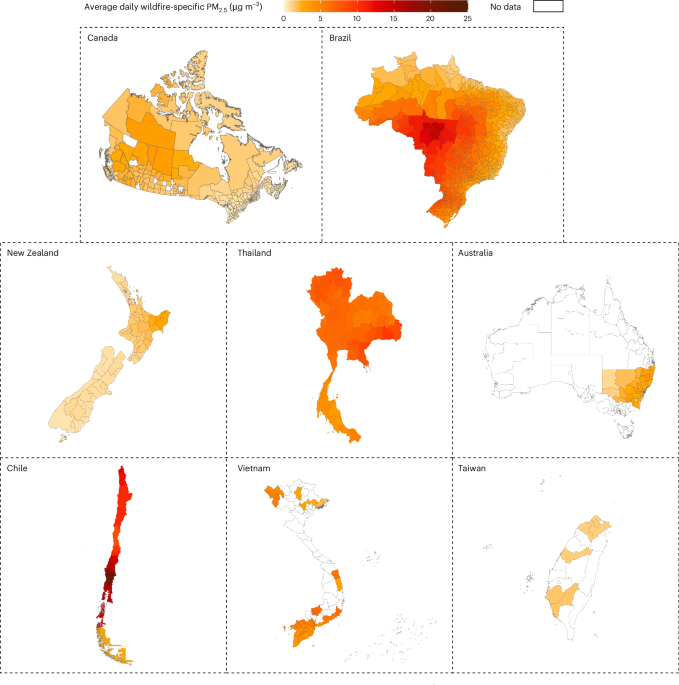
To the best of our knowledge, this is the largest study investigating the association between acute exposure to wildfire-specific PM2.5 and cause-specific respiratory hospitalizations. Overall, short-term wildfire-specific PM2.5 exposure was linearly associated with elevated risks in various respiratory hospitalizations, especially for influenza, individuals ≤19 or ≥60 years old, populations in low-income or high-polluted communities and residents of Brazil, Vietnam, Thailand and Taiwan. An estimated 1.42% (1.15–1.69%) of all-cause respiratory hospitalizations were attributable to wildfire-specific PM2.5, increasing overall, in Australia, Taiwan and Vietnam during various periods between 2010 and 2019. Compared with non-wildfire PM2.5, wildfire-specific PM2.5 posed a greater hospitalization risk for all the major type of respiratory diseases. Wildfire emerged as a notable source of PM2.5-linked respiratory hospitalizations overall, in Brazil, Chile, New Zealand, Thailand and Taiwan.
Our findings of the linear C–R relationship20,21 and the elevated risks of respiratory hospitalizations with short-term exposure to wildfire-specific PM2.5 were broadly in line with previous studies11,12,13,14,15,16,17,18,19. However, they mostly focused on several cities or territories within a single country and reported highly heterogeneous risk estimates. For example, a study in Darwin, Australia, found a 9.1% (RR = 1.091, 1.023–1.163) increase in all-cause respiratory hospitalizations per 10 µg m−3 increase in PM2.5 during bushfire events, one day after exposure22. Another study of the 2003 southern California wildfires found a 2.8% (RR = 1.028, 1.014–1.041) increase in respiratory hospitalizations for 10 µg m−3 increase in moving average PM2.5 exposure during the wildfire period23. Others found that a 10 μg m−3 increase in wildfire-related PM2.5 was associated with a 5.09% (RR = 1.0509, 1.0473–1.0544) increase in respiratory hospital admissions over 0–1 days after the exposure in Brazil during 2000–201514. The effect varied across studies possibly due to factors including study population and period, wildfire severity, exposure assessment and time window and modelling strategy. Our unified assessment approach across countries and territories ensured robust comparability and avoids potential publication bias.
The underlying mechanism for the health effects of wildfire-specific PM2.5 remains unclear. Nonetheless, the potential pathways by which PM2.5 affects the respiratory system may also apply to wildfire-specific PM2.5, including injury from free radical peroxidation, unbalanced intracellular calcium homeostasis and inflammation24. Other mechanisms for influenza and asthma are provided in Supplementary Discussion 1. In particular, the greater susceptibility of influenza could be due to greater transmission and gene modification of the influenza virus. Specifically, ambient PM2.5 is suggested as a direct transmission mode for influenza virus infection to the human alveolar epithelium, with nearly half (47%) of inhaled PM2.5 reaching the alveolar epithelium, the primary target site for influenza infection25. Furthermore, PM2.5 may not only act as a carrier but also influence the virus itself. PM2.5 components potentially modify the influenza virus genome25 and pre-exposure to PM2.5 may alter the antiviral response of bronchial epithelial cells, increasing their susceptibility to infection26. The unique characteristics of wildfire-specific PM2.5, including its chemical composition and long-range transport capability, might further facilitate this process, potentially increasing human susceptibility to influenza infection.
Aligned with a previous study in Southern California, 200323, we found that individuals ≤19 or ≥60 years old demonstrated a greater vulnerability to respiratory hospitalization associated with wildfire-specific PM2.5. Such stronger associations among children and adolescents might be explained by environmental, behavioural (for example, prolonged outdoor activities) and physiological factors (for example, underdeveloped detoxification systems)27. However, previous studies have yielded conflicting results. A meta-analysis suggested that young people might be less vulnerable to adverse respiratory effects from wildfire smoke exposure than are adults28. This discrepancy warrants further investigation.
Socioeconomic status played a complex role in the association between wildfire-specific PM2.5 and respiratory diseases. Individuals from disadvantaged communities experienced substantially amplified risks in respiratory hospitalization associated with wildfire-specific PM2.5, supported by a previous study in Northern California29. This greater vulnerability may be multifactorial, possibly including more childhood respiratory infections, lower housing conditions and indoor air quality, deficient nutrition and occupational exposures30. Further unravelling of how socioeconomic status modulates wildfire-specific PM2.5-related health effects demands use of multidimensional measures of socioeconomic status.
Non-wildfire PM2.5 significantly modified the association between wildfire-specific PM2.5 and respiratory hospitalizations. Consistent findings were observed across most respiratory diseases, indicating that individuals residing in areas with higher non-wildfire PM2.5 levels were more susceptible to wildfire smoke. This was probably due to impaired lung function20 affected by chronic exposure to PM2.5 from other sources. This finding is in line with a recent study from North Carolina, United States, reporting that individuals residing in areas with higher chronic PM2.5 exposure may exhibit heightened susceptibility to hospitalization during acute PM2.5 spikes31. Additionally, chronic inflammation resulting from regular exposures to higher levels of air pollution31 may further exacerbate the population susceptibility, during short-term increases in wildfire-specific PM2.5.
We observed significant spatiotemporal variations in hospitalization risks from respiratory diseases, related to wildfire-specific PM2.5. This may be attributed to differences in exposure levels of wildfire-specific and non-wildfire PM2.5, climate conditions, population susceptibility, basic health status and socioeconomic status (Supplementary Discussion 2). Specifically, as we discussed before, areas with higher levels of air pollution may bear greater health risks from wildfire smoke due to impaired lung function and chronic inflammation. This could contribute to the higher respiratory hospitalization rates in Taiwan, Brazil, Thailand and Vietnam, regions with historically higher median concentrations of non-wildfire PM2.5. Additionally, the pronounced annual concentrations of wildfire-specific PM2.5 may also play a role, a finding recently reported31. It is impractical for residents to stay indoors or seek shelter for extended periods, during prolonged wildfire smoke pollution events, as would be feasible for shorter periods, such as in Brazil, Thailand and Vietnam. What is more, housing design also varies across countries and territories. Hotter climates (tropical and subtropical) tend to have more open housing, which offers less protection from outdoor pollution. It is noteworthy that stronger associations of wildfire-specific PM2.5 with asthma hospitalization were found in Australia and New Zealand. This may be explained by poorer resident adaptability, substantial asthma burdens32,33 and high concentrations of various allergens (for example, pollen, dust mites and fungal spores)34. Furthermore, wildfire-specific PM2.5 toxicity can vary by biomass type and fire intensity across communities35. This could also contribute to the geographical disparities in the observed effect estimates.
During the study period, the proportions of respiratory hospitalizations attributable to wildfire-specific PM2.5 increased overall, in Australia, Taiwan and Vietnam. This rising burden could be attributable to increased population vulnerability and exposure to wildfire-specific PM2.5 (refs. 36,37). However, a decreasing trend was exhibited in countries commonly considered wildfire-prone areas (for example, Brazil, Canada and Chile). This may be due to improved resident adaptation ability, increased protective measures taken by residents and a long history of wildfire risk management38. Nonetheless, this does not diminish the severity or the need for addressing the wildfire-related health burden in these regions. While both Brazil and Chile have witnessed declines in the proportion of respiratory hospitalizations attributed to wildfire-specific PM2.5 exposure, wildfires remained a important contributor to PM2.5-linked respiratory hospitalizations in Brazil and the dominant source in Chile. This highlights a greater threat of PM2.5 from wildfire than non-wildfire sources.
The public health significance of PM2.5 from wildfire and non-wildfire sources could be different. A previous study reported that wildfire-specific PM2.5 may pose greater health risks than PM2.5 from other sources39. This may be due to the potential heightened toxicity of wildfire-specific PM2.5, accounting for an increased presence of smaller particles (for example, submicrometre particles and ultrafine particles) and a higher concentration of oxidative and pro-inflammatory components (for example, polycyclic aromatic hydrocarbons and aldehydes)1. This coincided with our findings that wildfire-specific PM2.5 posed a greater hospitalization risk for various respiratory diseases than did non-wildfire PM2.5. Therefore, continued mitigation efforts are warranted to attenuate and reverse the rising difference in the proportion of respiratory hospitalizations due to wildfire and non-wildfire particles, especially in Chile, New Zealand, Thailand, Taiwan and Vietnam.
As by far the largest study on the association between wildfire-specific PM2.5 and respiratory hospitalizations, this study has several strengths. First, we used an extensive multicountry dataset with high statistical power and a unified well-established two-stage analytical framework, including both the exposure assessment method and risk assessment model. This ensured the robustness, generalizability and comparison of the results across countries and territories. No previous study has done this comprehensive consistent assessment, for cause-specific respiratory hospitalization with wildfire-specific PM2.5. Second, the communities included in this study were predominantly regions with a history of wildfires and thereby serve as areas suitable for robust investigations on wildfire PM2.5 and respiratory health. Third, we identified vulnerable populations from different causes, which can inform the development of targeted interventions and aid in addressing environmental injustice. Fourth, the spatiotemporal assessment of the respiratory health burden attributable to wildfire-specific PM2.5 allows for a better understanding of the extent to which wildfire air pollution has affected different populations, in multiple countries and territories over varying periods. This may aid in resource allocation and more cost-effective policy-making. Finally, we compared the effect estimates, AF and spatiotemporal burden of respiratory hospitalizations attributable to wildfire and non-wildfire PM2.5 as few previous studies have reported such findings40. This provided supportive quantitative evidence on the stronger detrimental health effects of PM2.5 from wildfire relative to other sources.
Some limitations should be acknowledged. Despite extensive spatiotemporal coverage, our dataset was still incomplete. For example, some country- and territory-specific effect estimates may not be fully nationally representative as a result of the inclusion of a part of the communities. Specifically, Taiwan only had data from six municipalities; Australia only had data from New South Wales; and data from some communities did not cover the full study period. Moreover, although PM2.5 is the key component of wildfire smoke mixtures, other air pollutants such as ozone were not considered in this analysis. However, our results changed minimally when we controlled for wildfire-specific ozone in the model across all investigated causes. This suggests that the presence of wildfire-specific ozone has a negligible influence on the estimated effects of wildfire-specific PM2.5 on respiratory hospitalizations. Additionally, community-level wildfire-specific PM2.5 exposures were used in the analysis, which may not fully reflect personal exposures because of variations in housing quality and personal protective behaviours. The grid resolution used may not fully capture spatial variability, potentially leading to exposure measurement errors. To address this, we used population-weighted exposure. Overall, our results should be conservative given that a coarser exposure assignment may bias the effect estimates towards the null41. Meanwhile, the potential measurement error introduced by the uncertainties of the fire emission inventory, the GEOS-Chem simulations and machine learning models may also underestimate the effect estimates. Future studies with expanded health data, coupled with broader spatiotemporal coverage and more effect modifiers and air pollutants, could further advance the assessment of the health impacts of wildfire-specific air pollution.
Public health implications
Wildfire impacts are still likely to intensify as the global climate continues to warm1. In the context of the notable contribution of wildfire-specific PM2.5 exposure to respiratory burdens, prioritizing robust mitigation and adaptation strategies across diverse countries and territories emerges as a critical public health imperative, especially for diseases, populations and areas experiencing a greater susceptibility. Some solutions consist of raising awareness of wildfire-related health risks targeted at policy-makers, clinicians and the public, improving emission control, closely monitoring wildfire air pollution levels and strengthening community preparedness through resource planning and allocation.
link