


Booth, F. W., Roberts, C. K. & Laye, M. J. Lack of exercise is a major cause of chronic diseases. Compr. Physiol. 2, 1143–1211 (2012).
Google Scholar
Lee, D. C. et al. Leisure-time running reduces all-cause and cardiovascular mortality risk. J. Am. Coll. Cardiol. 64, 472–481 (2014).
Google Scholar
Kusuyama, J., Alves-Wagner, A. B., Makarewicz, N. S. & Goodyear, L. J. Effects of maternal and paternal exercise on offspring metabolism. Nat. Metab. 2, 858–872 (2020).
Google Scholar
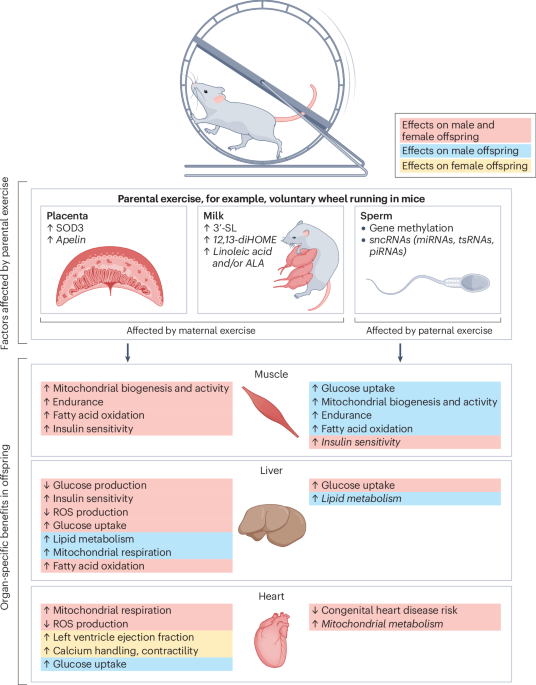
Pinckard, K. M. et al. Maternal exercise preserves offspring cardiovascular health via oxidative regulation of the ryanodine receptor. Mol. Metab. 82, 101914 (2024). This study shows the effects of maternal exercise on the cardiovascular health of offspring as they age, demonstrating sex-specific effects in females mediated by calcium handling.
Google Scholar
Wang, C. et al. Association of assisted reproductive technology, germline de novo mutations and congenital heart defects in a prospective birth cohort study. Cell Res. 31, 919–928 (2021). Through whole-genome sequencing of 407 offspring and their 365 families, the authors show that offspring of fathers who exercise carry less germline de novo mutations, a cause for congenital heart defects.
Google Scholar
Claycombe-Larson, K. G., Bundy, A. N. & Roemmich, J. N. Paternal high-fat diet and exercise regulate sperm miRNA and histone methylation to modify placental inflammation, nutrient transporter mRNA expression and fetal weight in a sex-dependent manner. J. Nutr. Biochem. 81, 108373 (2020).
Google Scholar
Costa-Júnior, J. M. et al. Paternal exercise improves the metabolic health of offspring via epigenetic modulation of the germline. Int. J. Mol. Sci. 23, 1 (2022). Methylation at CpG islands of main metabolic genes, including imprinting control regions, is replicated in sperm of exercised sires and muscle of their adult offspring, who show healthier muscle and whole-body metabolic phenotypes.
Google Scholar
Freitas-Dias, R. et al. Offspring from trained male mice inherit improved muscle mitochondrial function through PPAR co-repressor modulation. Life Sci. 291, 120239 (2022).
Google Scholar
Kusuyama, J. et al. Placental superoxide dismutase 3 mediates benefits of maternal exercise on offspring health. Cell Metab. 33, 939–956 (2021). This study describes a VDR–SOD3–AMPK–TET signalling mechanism that mediates the effects of maternal exercise on offspring liver through demethylation of glucose metabolism genes from embryonic stages to adulthood.
Google Scholar
Kusuyama, J. et al. Maternal exercise-induced SOD3 reverses the deleterious effects of maternal high-fat diet on offspring metabolism through stabilization of H3K4me3 and protection against WDR82 carbonylation. Diabetes 71, 1170–1181 (2022).
Google Scholar
Harris, J. E. et al. Exercise-induced 3′-sialyllactose in breast milk is a critical mediator to improve metabolic health and cardiac function in mouse offspring. Nat. Metab. 2, 678–687 (2020). The authors demonstrate a mechanism through which breast milk of exercised dams improves offspring metabolic and cardiovascular health through an oligosaccharide, 3′-sialyllactose.
Google Scholar
Wolfs, D. et al. Brown fat-activating lipokine 12,13-diHOME in human milk is associated with infant adiposity. J. Clin. Endocrinol. Metab. 106, E943–E956 (2021). In humans, 12,13-diHOME increases in breast milk with an acute bout of exercise and is associated with a healthier body composition at birth and during the first months of life.
Google Scholar
Son, J. S. et al. Maternal exercise via exerkine apelin enhances brown adipogenesis and prevents metabolic dysfunction in offspring mice. Sci. Adv. 6, eaaz0359 (2020).
Google Scholar
Sheldon, R. D. et al. Gestational exercise protects adult male offspring from high-fat diet-induced hepatic steatosis. J. Hepatol. 64, 171–178 (2016).
Google Scholar
Alves-Wagner, A. B. et al. Grandmaternal exercise improves metabolic health of second-generation offspring. Mol. Metab. 60, 101490 (2022). This study provides the metabolic phenotype of male and female second-generation (F2) offspring of exercised grandmother mice (F0) born through first-generation (F1) males.
Google Scholar
Martins Terra, M. et al. Multigenerational effects of chronic maternal exposure to a high sugar/fat diet and physical training. J. Dev. Orig. Health Dis. 11, 159–167 (2020).
Google Scholar
Hardy, D. B., Mu, X., Marchiori, K. S. & Mottola, M. F. Exercise in pregnancy increases placental angiogenin without changes in oxidative or endoplasmic reticulum stress. Med. Sci. Sports Exerc. 53, 1846–1854 (2021).
Google Scholar
Aparicio, V. A. et al. Influence of a concurrent exercise training program during pregnancy on the placenta mitochondrial DNA integrity and content of minerals with enzymatic relevance. The GESTAFIT project. Placenta 139, 19–24 (2023).
Google Scholar
Baena-García, L. et al. A concurrent prenatal exercise program increases neonatal and placental weight and shortens labor: the GESTAFIT project. Scand. J. Med. Sci. Sports 33, 465–474 (2022).
Google Scholar
Zhao, S. K. et al. Recreational physical activity before and during pregnancy and placental DNA methylation — an epigenome-wide association study. Am. J. Clin. Nutr. 116, 1168–1183 (2022).
Google Scholar
Ruebel, M. L. et al. Maternal exercise prior to and during gestation induces sex-specific alterations in the mouse placenta. Int. J. Mol. Sci. 24, 16441 (2023).
Google Scholar
Vinel, C. et al. The exerkine apelin reverses age-associated sarcopenia. Nat. Med. 24, 1360–1371 (2018).
Google Scholar
Son, J. S. et al. Exercise prevents the adverse effects of maternal obesity on placental vascularization and fetal growth. J. Physiol. 597, 3333–3347 (2019).
Google Scholar
Son, J. S. et al. Maternal inactivity programs skeletal muscle dysfunction in offspring mice by attenuating apelin signaling and mitochondrial biogenesis. Cell Rep. 33, 108461 (2020).
Google Scholar
Chae, S. A. et al. Exerkine apelin reverses obesity-associated placental dysfunction by accelerating mitochondrial biogenesis in mice. Am. J. Physiol. Endocrinol. Metab. 322, E467–E479 (2022).
Google Scholar
Moholdt, T. & Stanford, K. I. Exercised breast milk: a kick-start to prevent childhood obesity? Trends Endocrinol. Metab. 35, 23–30 (2024).
Google Scholar
Song, L. et al. Maternal exercise and high-fat diet affect hypothalamic neural projections in rat offspring in a sex-specific manner. J. Nutritional Biochem. 103, 108958 (2022).
Google Scholar
Ribeiro, T. A. et al. Maternal low intensity physical exercise prevents obesity in offspring rats exposed to early overnutrition. Sci. Rep. 7, 7634 (2017).
Google Scholar
Quiclet, C. et al. Maternal training during lactation modifies breast milk fatty acid composition and male offspring glucose homeostasis in rat. Biochim. Biophys. Acta Mol. Cell Biol. Lipids 1867, 159223 (2022).
Google Scholar
Bopp, M., Lovelady, C., Hunter, C. & Kinsella, T. Maternal diet and exercise: effects on long-chain polyunsaturated fatty acid concentrations in breast milk. J. Am. Diet. Assoc. 105, 1098–1103 (2005).
Google Scholar
Alexandre-Gouabau, M. C., David-Sochard, A., Royer, A. L., Parnet, P. & Paillé, V. Moderate high caloric maternal diet impacts dam breast milk metabotype and offspring lipidome in a sex-specific manner. Int. J. Mol. Sci. 21, 5428 (2020).
Google Scholar
Castillo, P. et al. Reverting to a healthy diet during lactation normalizes maternal milk lipid content of diet-induced obese rats and prevents early alterations in the plasma lipidome of the offspring. Mol. Nutr. Food Res. 66, e2200204 (2022).
Google Scholar
Martínez-Oca, P. et al. Maternal diet determines milk microbiome composition and offspring gut colonization in Wistar rats. Nutrients 15, 4322 (2023).
Google Scholar
Le Bourgot, C. et al. Maternal short chain fructo-oligosaccharides supplementation during late gestation and lactation influences milk components and offspring gut metabolome: a pilot study. Sci. Rep. 14, 4236 (2024).
Google Scholar
Zamanillo, R., Sánchez, J., Serra, F. & Palou, A. Breast milk supply of microRNA associated with leptin and adiponectin is affected by maternal overweight/obesity and influences infancy BMI. Nutrients 11, 2589 (2019).
Google Scholar
Shah, K. B. et al. Gestational diabetes mellitus is associated with altered abundance of exosomal microRNAs in human milk. Clin. Ther. 44, 172–185 (2022).
Google Scholar
Lowry, D. E., Paul, H. A. & Reimer, R. A. Impact of maternal obesity and prebiotic supplementation on select maternal milk microRNA levels and correlation with offspring outcomes. Br. J. Nutr. 127, 335–343 (2022).
Google Scholar
Matos, B., Howl, J., Ferreira, R. & Fardilha, M. Exploring the effect of exercise training on testicular function. Eur. J. Appl. Physiol. 119, 1–8 (2019).
Google Scholar
McPherson, N. O., Fullston, T., Bakos, H. W., Setchell, B. P. & Lane, M. Obese father’s metabolic state, adiposity, and reproductive capacity indicate son’s reproductive health. Fertil. Steril. 101, 865–873 (2014).
Google Scholar
Stanford, K. I. et al. Paternal exercise improves glucose metabolism in adult offspring. Diabetes 67, 2530–2540 (2018).
Google Scholar
McPherson, N. O., Owens, J. A., Fullston, T. & Lane, M. Preconception diet or exercise intervention in obese fathers normalizes sperm microRNA profile and metabolic syndrome in female offspring. Am. J. Physiol. Endocrinol. Metab. 308, E805–E821 (2015).
Google Scholar
Murashov, A. K. et al. Paternal long-term exercise programs offspring for low energy expenditure and increased risk for obesity in mice. FASEB J. 30, 775–784 (2016).
Google Scholar
Bartel, D. P. MicroRNAs: genomics, biogenesis, mechanism, and function. Cell 116, 281–297 (2004).
Google Scholar
Ingerslev, L. R. et al. Endurance training remodels sperm-borne small RNA expression and methylation at neurological gene hotspots. Clin. Epigenetics 10, 12 (2018).
Google Scholar
Lin, T. et al. Small RNA perspective of physical exercise-related improvement of male reproductive dysfunction due to obesity. Front. Endocrinol. 13, 1038449 (2022).
Google Scholar
Short, A. K. et al. Exercise alters mouse sperm small noncoding RNAs and induces a transgenerational modification of male offspring conditioned fear and anxiety. Transl. Psychiatry 7, e1114 (2017).
Google Scholar
Fullston, T. et al. Paternal obesity initiates metabolic disturbances in two generations of mice with incomplete penetrance to the F2 generation and alters the transcriptional profile of testis and sperm microRNA content. FASEB J. 27, 4226–4243 (2013).
Google Scholar
Chen, Q. et al. Sperm tsRNAs contribute to intergenerational inheritance of an acquired metabolic disorder. Science 351, 397–400 (2016).
Google Scholar
Tomar, A. et al. Epigenetic inheritance of diet-induced and sperm-borne mitochondrial RNAs. Nature 630, 720–727 (2024).
Google Scholar
Nätt, D. & Öst, A. Male reproductive health and intergenerational metabolic responses from a small RNA perspective. J. Intern. Med. 288, 305–320 (2020).
Google Scholar
Wu, P. H. et al. The evolutionarily conserved piRNA-producing locus pi6 is required for male mouse fertility. Nat. Genet. 52, 728–739 (2020).
Google Scholar
Hernández-Saavedra, D. et al. Maternal exercise and paternal exercise induce distinct metabolite signatures in offspring tissues. Diabetes 71, 2094–2105 (2022). Metabolomic analyses of offspring muscle, liver and heart describe the main tissue metabolic shifts in offspring in response to maternal exercise alone, paternal exercise alone, and maternal and paternal exercise together.
Google Scholar
Stanford, K. I. et al. Exercise before and during pregnancy prevents the deleterious effects of maternal high-fat feeding on metabolic health of male offspring. Diabetes 64, 427–433 (2015).
Google Scholar
Stanford, K. I. et al. Maternal exercise improves glucose tolerance in female offspring. Diabetes 66, 2124–2136 (2017).
Google Scholar
Liu, J. et al. Aerobic exercise preconception and during pregnancy enhances oxidative capacity in the hindlimb muscles of mice offspring. J. Strength. Cond. Res. 32, 1391–1403 (2018).
Google Scholar
Laker, R. C. et al. Exercise prevents maternal high-fat diet-induced hypermethylation of the Pgc-1α gene and age-dependent metabolic dysfunction in the offspring. Diabetes 63, 1605–1611 (2014).
Google Scholar
Beleza, J. et al. Gestational exercise increases male offspring’s maximal workload capacity early in life. Int. J. Mol. Sci. 23, 3916 (2022).
Google Scholar
Son, J. S. et al. Maternal exercise intergenerationally drives muscle-based thermogenesis via activation of apelin-AMPK signaling. EBioMedicine 76, 103842 (2022).
Google Scholar
Quiclet, C. et al. Maternal exercise modifies body composition and energy substrates handling in male offspring fed a high-fat/high-sucrose diet. J. Physiol. 595, 7049–7062 (2017).
Google Scholar
Jevtovic, F. et al. Myogenically differentiated mesenchymal stem cell insulin sensitivity is associated with infant adiposity at 1 and 6 months of age. Obesity 31, 2349–2358 (2023).
Google Scholar
Jevtovic, F. et al. Effects of maternal exercise on infant mesenchymal stem cell mitochondrial function, insulin action, and body composition in infancy. Physiol. Rep. 12, e16028 (2024). Complementing their previous study (ref. 60), Jevtovic et al. investigate metabolic substrate preference, insulin sensitivity and its association with later-in-life adiposity in myogenic, blood cord-derived mesenchymal stem cells of mothers engaging in an exercise programme.
Google Scholar
Krout, D. et al. Paternal exercise protects mouse offspring from high-fat-diet-induced type 2 diabetes risk by increasing skeletal muscle insulin signaling. J. Nutritional Biochem. 57, 35–44 (2018).
Google Scholar
Hinrichs, H., Faerber, A., Young, M., Ballentine, S. J. & Thompson, M. D. Maternal exercise protects male offspring from maternal diet–programmed nonalcoholic fatty liver disease progression. Endocrinology 164, bqad010 (2023).
Google Scholar
Bae-Gartz, I. et al. Maternal exercise conveys protection against NAFLD in the offspring via hepatic metabolic programming. Sci. Rep. 10, 15424 (2020).
Google Scholar
Kasper, P. et al. Maternal exercise mediates hepatic metabolic programming via activation of AMPK-PGC1 Axis in the offspring of obese mothers. Cells 10, 1247 (2021).
Google Scholar
Cunningham, R. P. et al. Maternal physical activity and sex impact markers of hepatic mitochondrial health. Med. Sci. Sports Exerc. 50, 2040–2048 (2018).
Google Scholar
Stevanović-Silva, J. et al. Exercise performed during pregnancy positively modulates liver metabolism and promotes mitochondrial biogenesis of female offspring in a rat model of diet-induced gestational diabetes. Biochim. Biophys. Acta Mol. Basis Dis. 1868, 166526 (2022).
Google Scholar
Stevanović-Silva, J. et al. Maternal high-fat high-sucrose diet and gestational exercise modulate hepatic fat accumulation and liver mitochondrial respiratory capacity in mothers and male offspring. Metabolism 116, 154704 (2021).
Google Scholar
Siti, F. et al. Maternal exercise before and during gestation modifies liver and muscle mitochondria in rat offspring. J. Exp. Biol. 222, jeb194969 (2019).
Google Scholar
Batista, R. O. et al. Paternal exercise protects against liver steatosis in the male offspring of mice submitted to high fat diet. Life Sci. 263, 118583 (2020).
Google Scholar
Lefebvre, P. & Staels, B. Hepatic sexual dimorphism — implications for non-alcoholic fatty liver disease. Nat. Rev. Endocrinol. 17, 662–670 (2021).
Google Scholar
Chung, E. et al. Maternal exercise upregulates mitochondrial gene expression and increases enzyme activity of fetal mouse hearts. Physiol. Rep. 5, e13184 (2017).
Google Scholar
Saiyin, T. et al. Maternal voluntary exercise mitigates oxidative stress and incidence of congenital heart defects in pre-gestational diabetes. J. Cell Mol. Med. 23, 5553–5565 (2019).
Google Scholar
Ye, F., Lu, X., van Neck, R., Jones, D. L. & Feng, Q. Novel circRNA-miRNA-mRNA networks regulated by maternal exercise in fetal hearts of pregestational diabetes. Life Sci. 314, 121308 (2023).
Google Scholar
Schulkey, C. E. et al. The maternal-age-associated risk of congenital heart disease is modifiable. Nature 520, 230–233 (2015).
Google Scholar
Beeson, J. H. et al. Maternal exercise intervention in obese pregnancy improves the cardiovascular health of the adult male offspring. Mol. Metab. 16, 35–44 (2018).
Google Scholar
De Sousa Neto, I. V. et al. Paternal resistance training induced modifications in the left ventricle proteome independent of offspring diet. Oxid. Med. Cell Longev. 2020, 5603580 (2020).
Google Scholar
Schellong, K. et al. Maternal but not paternal high-fat diet (HFD) exposure at conception predisposes for ‘diabesity’ in offspring generations. Int. J. Env. Res. Public Health 17, 4229 (2020).
Google Scholar
Takahashi, Y. et al. Transgenerational inheritance of acquired epigenetic signatures at CpG islands in mice. Cell 186, 715–731 (2023).
Google Scholar
link